




Alyssa Roenigk

Multiple Authors
TWO MONTHS AFTER the most devastating crash of her career, Lindsey Vonn walks into the sun-drenched living room of a home in Beverly Hills that’s been rented for the day. She’s wearing a neon yellow suit jacket, black pants and tennis shoes, and using crutches to make her way across the room. “I never wear tennis shoes,” she says.
Vonn flew to Los Angeles, where she has a second home, to promote an educational campaign with a biopharmaceutical company around antibodies and disease prevention. “I was definitely leaning on that wheelchair assistance,” she says of her airport experience. She started using crutches for the first time since the crash on the day she flew to L.A. “It’s been a very slow process,” she says.
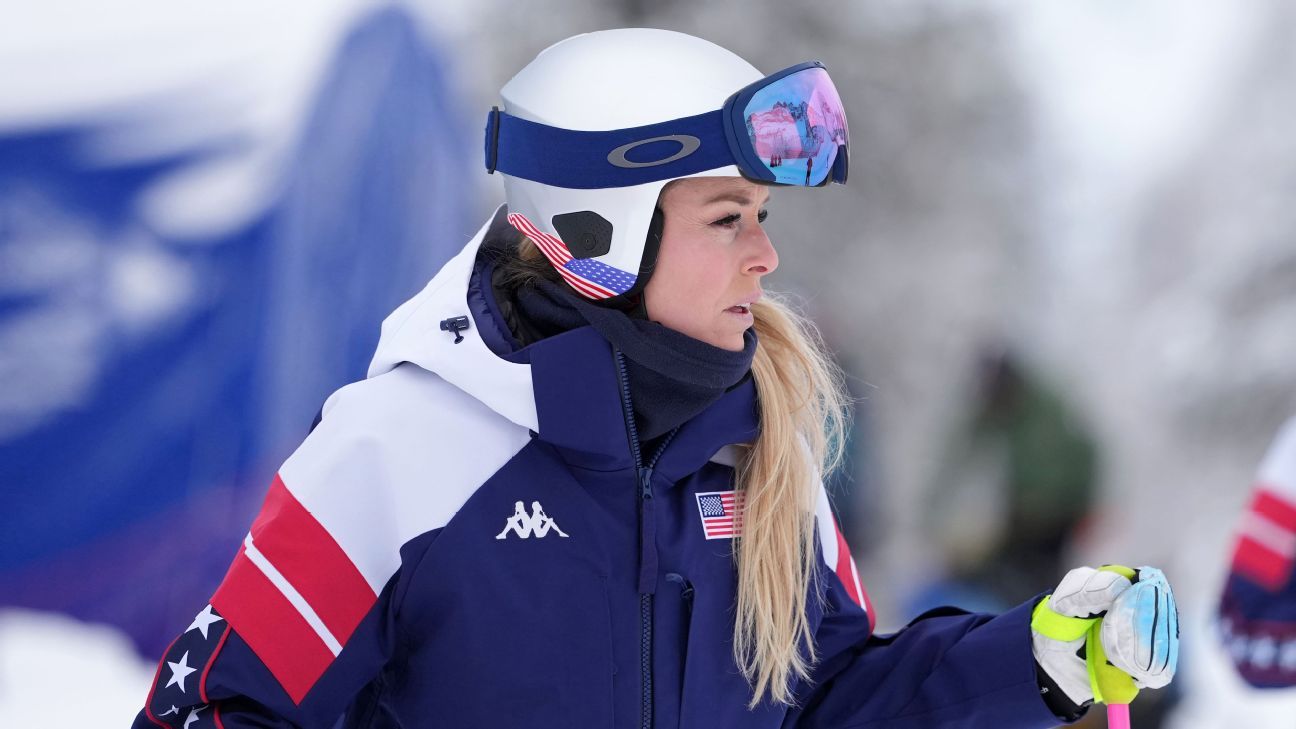
Vonn is slowly returning to life as she knew it before a crash 13 seconds into her Olympic downhill run left her with a broken right ankle and complex fractures in her left tibia and fibula. She’s traveling, rebuilding the strength she lost and is way overdue for a highlight. “It’s been since before the Olympics,” she says. “I’m so ready.”
She’s also ready to tell her story, in her voice. She sits down for her second on-camera interview since the Olympics, and the first away from the security and isolation of her home in Park City, Utah. She hands off her crutches, crosses her legs at her ankles and waits as her stylist tames a few last flyaways. Vonn has spent enough time reading other people’s takes on her comeback, her decision to race the Olympic downhill with a torn ACL and whether she’ll step into another start gate again. It’s her turn.
Editor’s note: This conversation has been edited for length and clarity.
ESPN: Lindsey, how are you doing?
Lindsey Vonn: I’m doing well. I’m getting there for sure. It’s been a very slow process. Definitely the first three weeks were really intense, a lot of pain. But, you know, I slowly moved out of that phase and now I’m on crutches. I’m definitely tired. Trying to crutch around is a challenge, but I’m getting there.
ESPN: What brings you to Los Angeles this week?
Vonn: I live here part time and I’ve been kind of hunkered down in Utah doing all my rehab and I’ve been really isolated. So it’s nice to get to L.A. where there’s more people. I’m actually here as a partner of Invivyd and we’re talking about antibodies with the national education campaign, which I’m really excited about because I’ve always been focused on my health, obviously. But now in this phase of my life, I have something positive to focus on and helping explain what antibodies do for our immune system and helping fight against germs and toxins, is really rewarding.
ESPN: What are your short-term goals?
Vonn: Getting stronger, getting better, getting healthy, getting back into the real world and then finding things that I’m passionate about. I don’t really know what the long-term future is. I was so focused for the last two years on the Olympics that I still haven’t processed the fact that my Olympics are over. My season is over. I may never race again. I haven’t made any determinations on the future because I still haven’t processed what’s happened in the past six weeks.
ESPN: In your first social media post after the crash, one of the things that stuck with people, stuck with me, was you saying that just being in that start gate knowing you could win was a win in itself. When was the last moment you felt fully in control?
Vonn: I mean, I was fully in control until I hit that panel, to be honest. I was in such a good mental state. Despite my ACL, I was physically in a great place. I felt strong. I know that course like the back of my hand. I know exactly what to do. My crash was so unlikely and improbable and something I would have never in a million years guessed would happen. But those are the margins that you’re playing with in downhill.
I stood in the starting gate knowing that I could win the race, and that was the only medal that I was looking forward to. I didn’t make it very far, but I actually made it really far because I was 41 years old with a partial knee replacement and no ACL. And the fact that I was there was a huge victory in itself. And I think everyone’s been so focused on the crash that the overall story has been somewhat overshadowed by it.
ESPN: When you went into the Olympics, you were ranked No. 1 in the world. You wanted to win the downhill at the Olympics, you wanted to win the World Cup title. What was it like to watch other people take those?
Vonn: The downhill title was harder to watch than the Olympics. I was so focused on survival in the hospital that the time went by so quickly. And I was also really happy for my teammates, so I think that somehow made it easier. But I had such a big lead in the downhill standings, and then I just slowly watched it get less and less and less, and I still was really close to winning it, even though I missed half the season, which I think says a lot about how the beginning of the year started and what I was able to do. I have to be really proud of that.
ESPN: And those podiums, those wins, also helped the team win their first FIS Alpine Nations Cup since 1982. What solace and pride do you take in knowing that you were part of one of the most successful U.S. women’s alpine teams in decades?
Vonn: Our team was amazing. I think we’ve had really strong speed teams in the past. But, the depth of the technical team was important to be able to get to that point where we could win the Nations Cup. My team called me and they FaceTimed me when they won, and a couple coaches texted me, you know, ‘If we didn’t have your 500 and whatever points, we wouldn’t have won.’ So it was nice to be a part of that and also for them to help me feel better about not being there through to the end, but that I did contribute.
ESPN: What do you worry people misunderstand about the crash?
Vonn: Everyone had their opinion on that crash — that it was because of my ACL, and it was because I was old and because my reaction time wasn’t fast enough. And people that have no understanding of my sport and what it takes to succeed or how easily it is to have a major crash, they were commenting so strongly, but they had no idea. And that was frustrating because I felt helpless in the hospital that I didn’t have a voice to correct them. And I think sometimes giving in to those types of comments gives them a louder voice, which I didn’t want to do, either. But my crash had nothing to do with my ACL. I want people to understand that I was ready, I was strong no matter my age, no matter what condition my body was in. I was ready. I made a small error, and that’s the price I paid. But I would do it again if I had a chance.
ESPN: Taken all together, if you knew what you know now, but you can’t change anything about it …
Vonn: You still do it.
ESPN: All of it?
Vonn: As hard as it is for me right now, and there have been some very, very low moments, I don’t regret it because I had such an amazing time. I feel like this has been my second chance. My first career was incredible, and I never would have expected to be where I was. I never expected to come back, and so no matter what happened, it was icing on the cake. I wish I had a cherry on top, but the cake still tastes pretty good.
ESPN: How much does wanting to rewrite your ending factor into your future and your decision making?
Vonn: Well, I don’t necessarily want to rewrite it. I mean, it is what it is. It happened, and I can’t change that. But I know that I have a lot left in my life. There’s so much more to be written, and I think eventually people will maybe not remember the crash as much as right now because it’s so fresh. But there’s nothing I can do besides trying my best to move forward and continue to push the limits on whatever it is I choose to do in life.
ESPN: Where would you have to be, what would have to be happening emotionally, physically, to draw you into another start gate?
Vonn: I think just honestly to say goodbye. You know, I never got a chance to say goodbye to my teammates, to my other friends who are my competitors on the World Cup, the coaches. I felt like I was just taken away in a helicopter and never saw anyone again. And that was honestly a worse ending than I had the last time I retired. When I think back on the season, I just think of how much fun I had, and I loved it. There were so many positive things about it outside of skiing. Everything about it was amazing. And I don’t know if I could ever recreate that.
It just really depends on what my life looks like outside of skiing going forward. I had a very fulfilling life for the last six years before I did this comeback. I can’t tell you what things will look like in a year. I know I need another surgery, so just getting past that point is my goal, and then we’ll see. But going back in the starting gate, I think there would need to be a lot of factors that would have to line up. I’d say the chances are low, but it’s not an improbability.
ESPN: Where are you with your injuries and your recovery?
Vonn: The last surgery was in Vail. Dr. [Tom] Hackett put a lot of metal to fix all of the fractures in my tibia. My fibular head was also broken, but that was left alone. So right now I’m just trying to get everything strong, make sure my muscles are working. He had to maneuver around a lot of nerves and muscle tissue. With the fasciotomy that I had because of the compartment syndrome, my scars are big. [Compartment syndrome is a condition in which excessive pressure build-up inside a muscle from bleeding or swelling restricts blood flow and can lead to permanent injury if not treated quickly.] So far, everything’s going really well. My muscles are great. I have control. I still need one more surgery to remove the hardware. And then I have to fix the ACL at the same time, which probably would require three to four weeks on crutches, and then I’ll be off to the races.
ESPN: Why was this so much more difficult than other injuries or crashes in your career?
Vonn: The injury was incredibly painful. The amount of surgeries I needed, the amount of time in the hospital. The pain was probably the worst part of it. I just didn’t feel like myself. I hate the feeling of not being able to do things myself. I’m a person that loves to be independent, and maybe I’m a little bit too stubborn that way. But I don’t like asking for help. I really had to allow people to help me.
When you crash normally and tear your ACL, your MCL, you have pain, but it’s not that severe and it’s not for that long. I had 12 hours of, like, I was screaming at the top of my lungs. I was sweating. I hope I never experience that again. I hope no one experiences that.
ESPN: You always watch your crashes. Did you watch this one?
Vonn: It took me a while. You can’t see much. But when I finally come to a stop and my legs are kind of contorted, I knew immediately that my leg was broken. I don’t like reliving that thought and that feeling and knowing that everything had changed in that moment.
ESPN: What was the first thing you thought when you came to a stop?
Vonn: I couldn’t believe it. I knew my leg was broken. And the first thing I thought was, ‘Don’t get compartment syndrome.’
ESPN: It was the first thing that you thought of?
Vonn: Literally the first thing I thought of. I was panicked and I was telling the doctor, like, “Don’t let me get compartment syndrome.” And then, of course I did.
ESPN: What was the moment when you realized this was not just about your future in ski racing, that you could lose your leg?
Vonn: It wasn’t until I woke up from my first surgery and I was screaming because the pain had just really gone through the roof. And Dr. Hackett was there and he was like, “Don’t worry, I’m gonna scrub in. I’m gonna save your leg.”
ESPN: When was the first moment that you felt hope for the future?
Vonn: Finally being able to stand up on my own and try to walk again and not feeling like if the wind blew too hard, I would fall over. I did some pull-ups the other day and I was like, “Okay. I can still do this.” That made me feel stronger.”
ESPN: What have you learned about yourself in the past two months?
Vonn: I mean, I’ve always thought that, because of my grandparents, my parents, I’m a pretty tough person. I can handle a lot. That’s how I was raised. But, man, I can handle a lot.
ESPN: When you take in all of what you’ve been through, if you could go back and say one thing to Lindsey Vonn the day before you announce your comeback, what do you say to her?
Vonn: I wouldn’t say anything. For how many ups and downs I’ve had in my life, it’s all taught me something. Everything happens for a reason. Sometimes it takes longer to figure out what that reason is and what lesson it’s taught me. But it’s gotten me to this point, and I have to be thankful for where I am. I’m lucky to have done what I love to do, to go fast, to have a smile on my face, to stand on the podium one more time. If I would have given myself advice, who knows if I would have gotten there. So you gotta live. You have to learn. You have to fall. That’s what we do in life, and I wouldn’t change that.


