

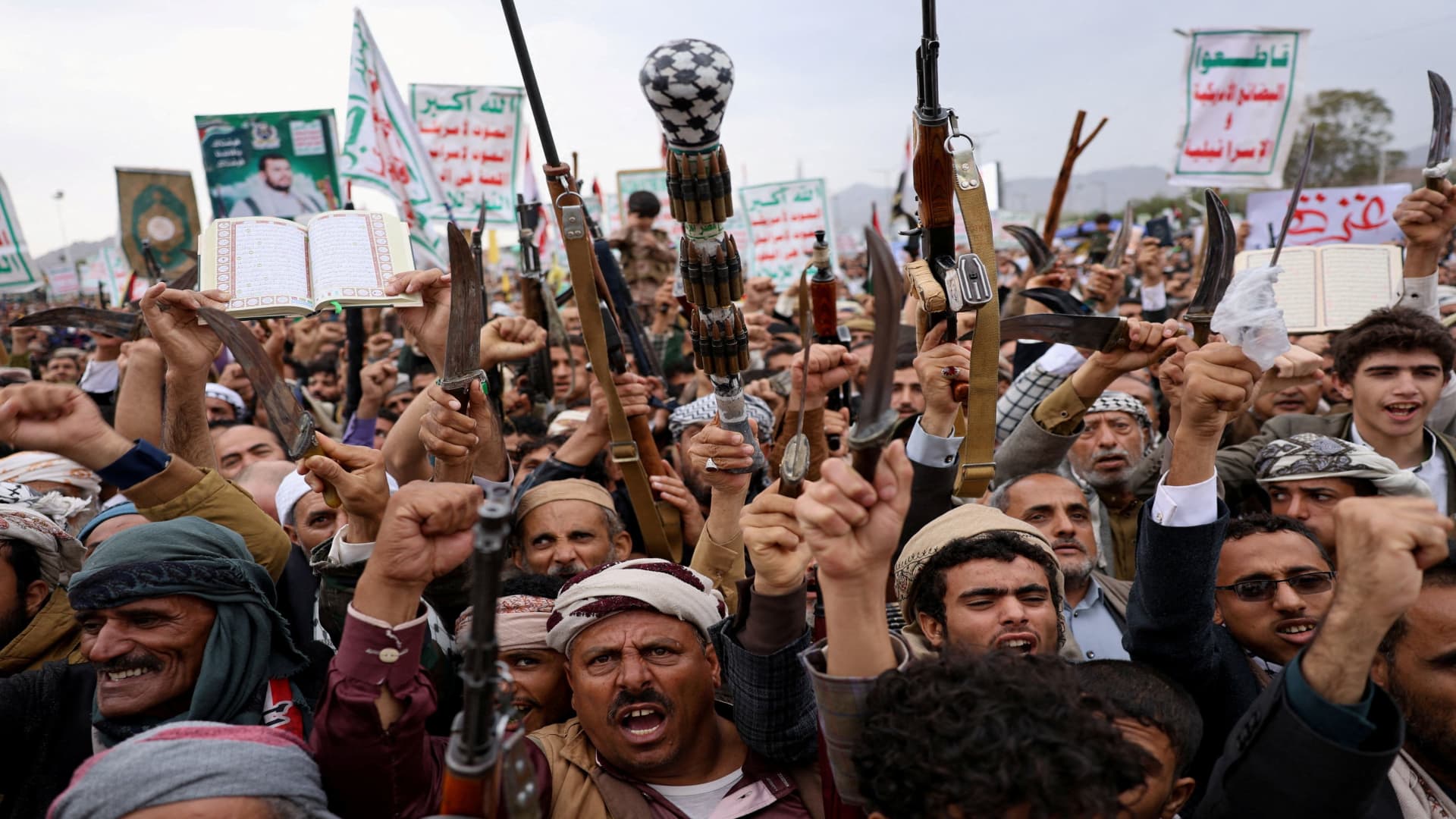
Protesters, predominantly Houthi supporters, demonstrate in solidarity with Palestinians, in Sanaa, Yemen on Aug. 1, 2025.
Khaled Abdullah | Reuters
Yemen’s Houthis launched a missile strike against Israel, the group said Saturday. It was the first time the Tehran-backed militia had intervened in the U.S.-Israeli-led war against Iran, which has entered its second month.
“The Yemeni Armed Forces … have carried out the first military operation using a barrage of ballistic missiles targeting sensitive Israeli military sites,” Houthi spokesman Yahya Saree said in a post on X.
Saree said the strike was in support of Iran’s regime and Hezbollah forces in Lebanon.
The Israel Defense Forces said they “identified the launch of a missile from Yemen towards Israel,” adding that its aerial defenses intercepted the threat.
The move by the Houthis marks an escalation in the conflict, which began with U.S. and Israeli airstrikes against Iranian targets on Feb. 28.
Analysts have told CNBC that the Houthis could attempt to choke off maritime traffic through the Bab el-Mandeb Strait, separating the Arabian Peninsula and the Horn of Africa — through which ships must pass to reach the Red Sea and the Suez Canal — adding to pressure on global trade.
Early Saturday, Danish shipping giant Maersk, widely regarded as a barometer of global trade, responded to reports of drone activity and explosions that occurred at the Port of Salalah in Oman.
“We are pleased to confirm that all Maersk crew are safe and accounted for and no Maersk vessels or cargo have been affected,” the company said in a statement. “Following the incident in which a terminal crane sustained damage and a port worker suffered minor injuries, the port was immediately evacuated and operations across the facility were temporarily suspended.”
Maersk had said earlier in March that the situation in the Middle East had prompted it to pause future trans-Suez sailings through the Bab el-Mandeb Strait until further notice.
The Port of Salalah remains in full cooperation with relevant authorities and Maersk’s current estimate is that operations will be on hold for approximately 48 hours. We will inform customers if there are any changes to this timeline as soon as information becomes available.
The Bab el-Mandeb Strait was estimated to account for 12% of seaborne oil trade and 8% of liquefied natural gas trade in the first half of 2023.
Iranian forces have already effectively shut down the Strait of Hormuz between Iran and the Arabian Peninsula, through which about 20% of the world’s oil supplies moved before the war.
Oil prices on Friday closed at their highest level in more than three years, as President Donald Trump’s pivot toward negotiations with Iran failed to ease market fears about the huge supply disruption in the Middle East.

West Texas Intermediate crude oil price, one year
U.S. crude oil prices rose 5.46% to close at $99.64 per barrel. International benchmark Brent crude prices gained 4.22% to settle at $112.57.
Trump’s move to give Iran a 10-day extension to open the strategically vital Strait failed to soothe supply concerns. The president said in a social media post on Thursday that talks with Iran were “going very well” despite “erroneous statements to the contrary by the Fake News Media, and others.”
As part of the announcement, the U.S. president said he would pause attacks on Iran’s energy infrastructure through April 6. Iran has not yet commented on Trump’s latest remarks.
U.S. troops suffer casualties at Saudi base: AP
More than two dozen U.S. troops have been wounded in Iranian attacks on Saudi Arabia’s Prince Sultan Air Base in the past week, according to two people who have been briefed on the matter. Iran fired six ballistic missiles and 29 drones at the base Friday, injuring at least 15 troops, including five seriously, according to the sources who were not authorized to comment publicly and spoke on the condition of anonymity.
The base, about 96 kilometers (60 miles) from the Saudi capital of Riyadh, came under attack twice earlier in the week, including a strike that wounded 14 U.S. troops, according to the people briefed on the matter. The base is run by the Royal Saudi Air Force but is also used by U.S. troops.
Attempts at diplomacy as U.S. sends more troops
The latest attacks happened after Trump claimed that talks on ending the war were going “very well.” Iran says it has not engaged in any negotiations.
With the economic repercussions from the war extending far beyond the Middle East, Trump is under growing pressure to end Iran’s chokehold on the strait.
Pakistan said Saturday that Saudi Arabia, Turkey and Egypt will send their top diplomats to Islamabad for talks aimed at ending the war.
Foreign Minister Ishaq Dar said in a statement that Saudi Foreign Minister Prince Faisal bin Farhan, Turkey’s Foreign Minister Hakan Fidan and Egypt’s Foreign Minister Badr Abdelatty will arrive Sunday for a two-day visit to “hold in-depth discussions on a range of issues, including efforts to de-escalate tensions in the region.”
Pakistan’s Prime Minister Shehbaz Sharif said Saturday that he and Iranian President Masoud Pezeshkian held “extensive discussions” on regional hostilities and efforts aimed at end the war.
Also, on Saturday, the Iranian foreign minister, Abbas Araghchi, told his Turkish counterpart by phone that Iran was skeptical about recent diplomatic efforts to stop the war. Iranian state-run media reported that Araghchi accused the United States of making “unreasonable demands” and engaging in “contradictory actions,” raising doubts about the prospect of an agreement.
Trump envoy Steve Witkoff has said Washington delivered a 15-point “action list” to Iran for a possible ceasefire, with a proposal to restrict Iran’s nuclear program and reopen the strait. Tehran rejected the proposal and presented its own five-point proposal that included reparations and recognition of its sovereignty over the waterway.
Meanwhile, U.S. ships drew closer to the region carrying some 2,500 Marines, and at least 1,000 paratroopers from the 82nd Airborne, who are trained to land in hostile territory to secure key positions and airfields, have been ordered to the Middle East.
Secretary of State Marco Rubio said the U.S. “can achieve all of our objectives without ground troops.”
Death toll climbs
Iranian authorities say more than 1,900 people have been killed in the Islamic Republic, while 19 have been reported dead in Israel.
In Lebanon, where Israel has started an invasion in the south, officials said more than 1,100 people have been killed since the start of the war.
Meanwhile, at least 13 U.S. troops have been reported killed, while in Iraq, where Iranian-supported militia groups have entered the conflict, 80 members of the security forces have died.
In the Gulf states, 20 people have been killed and four others in the occupied West Bank.
The U.N.’s International Organization for Migration also said Friday that 82,000 civilian buildings in Iran, including hospitals and the homes of 180,000 people, were damaged.
Israel strikes Iranian nuclear facilities
Israel focused its Friday attacks on sites “in the heart of Tehran” where ballistic missiles and other weapons are produced, the military said. It said it also hit missile launchers and storage sites in Western Iran, while witnesses in eastern Tehran reported a partial power outage following airstrikes.
Iran’s Atomic Energy Organization said the Shahid Khondab Heavy Water Complex in Arak and the Ardakan yellowcake production plant in Yazd Province were targeted, IRNA reported. The strikes did not cause casualties and there was no risk of contamination, it said.
Yellowcake is a concentrated form of uranium after impurities are removed from the raw ore. Heavy water is used as a moderator in nuclear reactors.
The Israeli military later said raw materials are processed for enrichment at the Yazd plant and the strike was a major blow to Iran’s nuclear program. Tehran vowed to retaliate.
Possible breakthrough to allow aid, farm shipments
Iran agreed to allow humanitarian aid and agricultural shipments through the Strait of Hormuz following a request from the United Nations. Ali Bahreini, the country’s ambassador to the U.N. in Geneva, said Iran agreed to “facilitate and expedite” such movement.
The vital waterway usually handles a fifth of the world’s oil shipments and nearly a third of the world’s fertilizer trade. While markets and governments have largely focused on blocked supplies of oil and natural gas, restrictions on fertilizer ingredients and trade threaten farming and food security around the world.
— The Associated Press contributed to this report.