









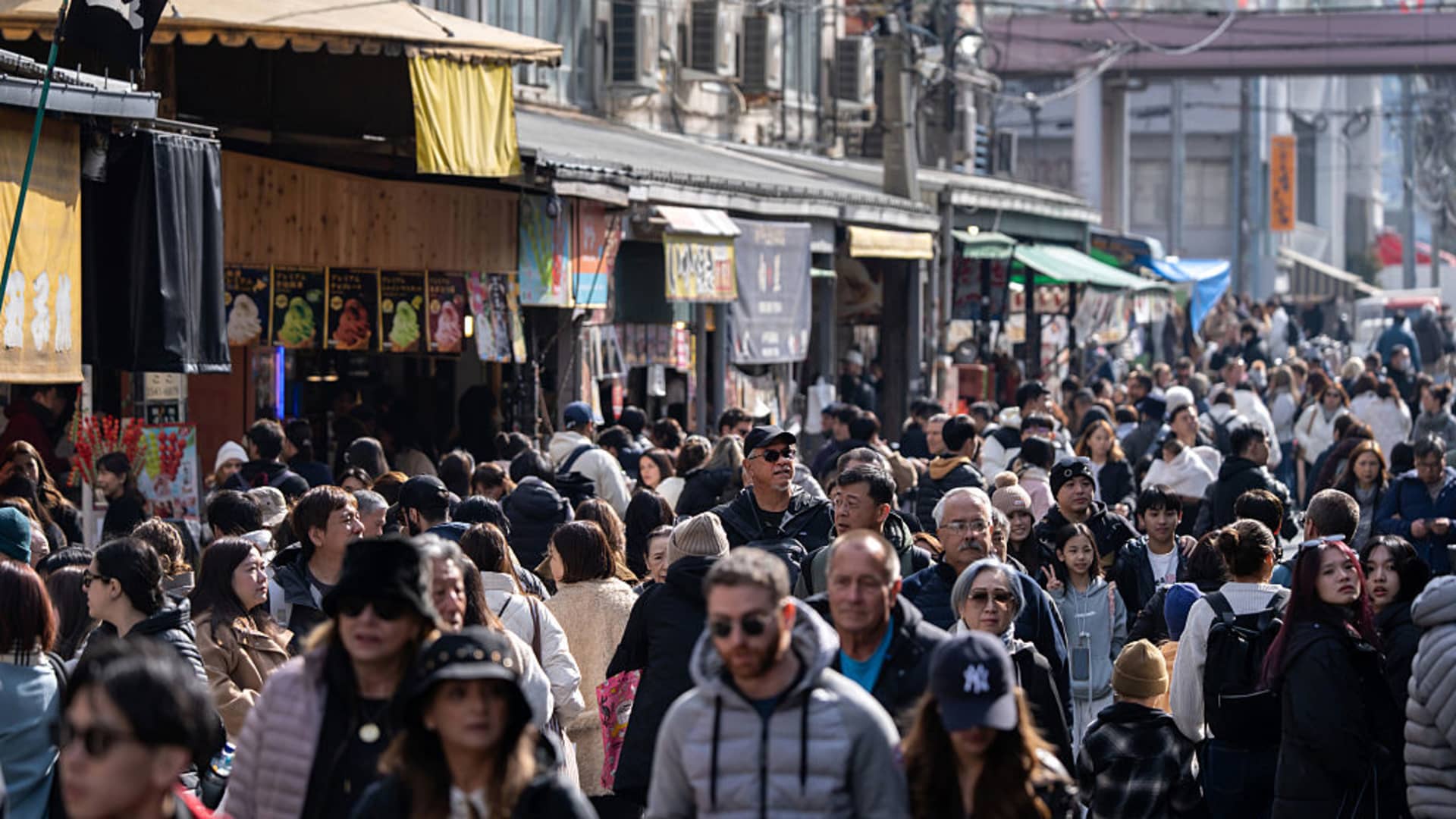
TOKYO, JAPAN – FEBRUARY 05: Tourists and shoppers walk through the Tsukiji shopping area on February 5, 2026 in Tokyo, Japan.
Tomohiro Ohsumi | Getty Images News | Getty Images
The Bank of Japan has long stated that sustained levels of inflation will help it move ahead with policy normalization, after having ended the world’s only negative interest rate regime in 2024.
Headline inflation in Japan has run above the BOJ’s 2% target for 45 straight months, only cooling in January 2026. And now the war in the Middle East risks fueling it further, something that the central bank flagged when it kept rates steady on Thursday.
For Japan, a country that imports nearly all of its oil, this is the wrong kind of “cost‑push” inflation, rather than the “demand‑pull” rise in prices the BOJ has been seeking. “Cost-push” inflation refers to increase in prices due to external factors, instead of an rise in domestic spending power.
Meanwhile, Iran has threatened to escalate tensions until oil reaches “$200 per barrel.”
Making matters worse is that these supply-side inflation risks come against the backdrop of an extended slide in wages in the country. Real wages fell every month in 2025, before gaining 1.4% in January.
The BOJ has been looking for inflation fueled by wage growth — a virtuous cycle of price and wage increases. Prime Minister Sanae Takaichi reportedly has also urged the BOJ to ensure that its inflation target is met, not by rising raw material costs, but wage increases.
Thomas Rupf, chief investment officer for Asia at private bank VP Bank, told CNBC that inflation is expected to increase noticeably from March onward. “Higher global energy prices following the conflict, combined with Japan’s heavy reliance on imported energy and a weaker yen, will likely pass through quickly to consumer prices.”
Inflation could rebound beyond 2%, Rupf added.

On Tuesday, Ueda also said underlying inflation in Japan was accelerating toward the bank’s 2% target, reiterating that price rises must be matched by solid wage gains.
Earlier this month, he had reportedly told Japan’s parliament that rising crude oil prices would worsen Japan’s terms of trade and hurt the economy, and if high oil prices persist, it could push up underlying inflation.
Energy impact
Sam Jochim, economist at Swiss private bank EFG told CNBC that while energy makes up 7% of Japan’s CPI basket, and as such, a 10% increase in energy prices should directly translate to a 0.7% rise in overall inflation.
But it is not as simple as that, he pointed out, saying that “energy is an important input in the production of many goods and services, and so, the overall increase in inflation would likely be even larger than this.”
Hirofumi Suzuki, chief FX strategist and head of research at Sumitomo Mitsui Banking Corporation, also shares that view.
Suzuki said that while the impact on inflation in Japan is limited for the time being, for every 20% increase in oil prices, Japan’s CPI will increase by 0.3%. Suzuki has a pre-war baseline oil price of $60 per barrel.
“We think that this is increasing the risk that upward pressure on overall prices could strengthen materially.”
The silver lining is that Japan has significant oil reserves to mitigate this price shock to a certain extent. The country held emergency oil reserves equivalent to 254 days of domestic consumption as of February, according to government data.
BOJ’s policy bind
A “cost-push” scenario would force the BOJ into a policy bind, as it will then have to deliberate between hiking rates to curb inflation, or holding rates, to sustain growth in the world’s fourth-largest economy.
VP Bank’s Rupf suggested that if inflation rises while fiscal policy remains supportive, the central bank might need to move somewhat faster with normalization, as cost‑driven inflation reduces real wages and weighs on consumption.
Typically, higher rates constrain inflation by making borrowing more expensive and slowing economic growth.
EFG’s Jochim pointed out that inflation caused by rising external energy prices would be viewed as a supply shock, which would crimp economic growth, thus creating a difficult trade-off for the BOJ.
Analysts had previously told CNBC that raising rates would do little to stem “cost-push” inflation as rates target demand.
“As such, it is more realistic to expect the BOJ to adopt a wait and see approach rather than rushing to raise rates to battle higher inflation,” he said.