

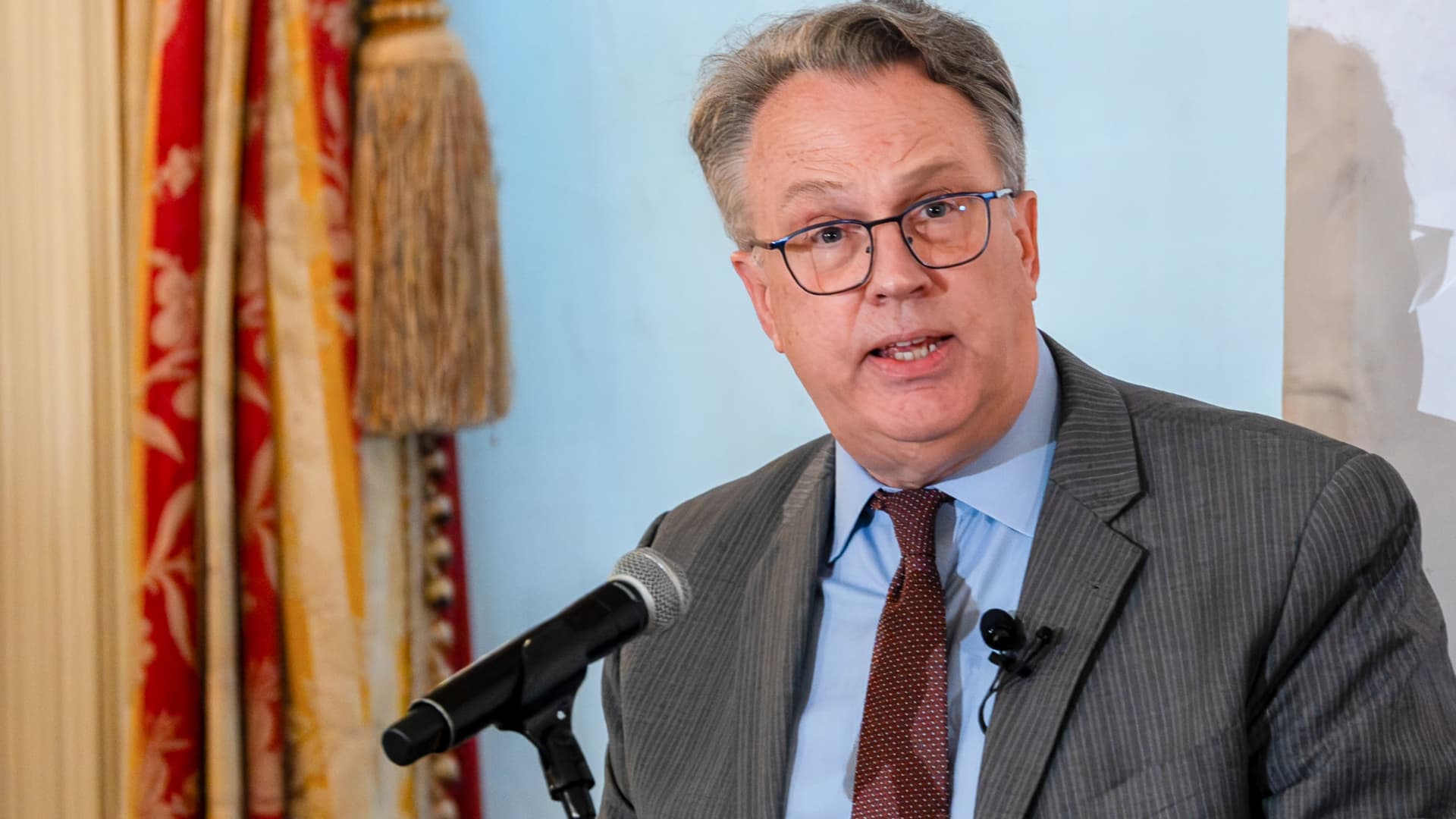
John Williams, president and chief executive officer of the Federal Reserve Bank of New York, speaks during an Economic Club of New York (ECNY) event in New York, US, on Thursday, Sept. 4, 2025.
David Dee Delgado | Bloomberg | Getty Images
American consumers and businesses are taking most of the hit from President Donald Trump’s tariffs, New York Federal Reserve President John Williams said Tuesday in remarks that counter White House claims.
“The tariffs have overwhelmingly been borne domestically — a New York Fed analysis estimates that most of the burden has fallen on U.S. firms and consumers.,” Williams said in remarks for a conference in Washington, D.C. “In addition, the tariffs have already meaningfully increased U.S. prices of imported goods, and the full effects have likely not yet been felt.”
The study Williams cited has generated a fair amount of controversy over the past few weeks.
In a white paper published on the New York Fed’s website, a team of researchers found that as much as 90% of the added cost from tariffs has been passed on to domestic producers and consumers. Trump and other White House officials had insisted that exporters would absorb the costs rather than raise prices.
National Economic Council Director Kevin Hassett flamed the controversy during a CNBC appearance in which he suggested that the researchers should be “disciplined” for what he termed was “the worst paper I’ve ever seen in the history of the Federal Reserve system.” Hassett later stepped back the criticism.
Addressing the issue for the first time publicly, Williams said that not only were the tariffs being felt at home, but they also were keeping the Fed from reaching its 2% inflation goal.
“My current estimate is that, to date, the increase in tariffs has contributed around one half to three quarters of a percentage point to the current inflation rate of about 3 percent,” he said. “The FOMC defines price stability as 2 percent inflation over the longer run. Owing to the effects of tariffs, progress toward that goal has temporarily stalled.”
On the bright side, Williams said he still expects the tariff impact on inflation to be temporary, and he sees the Fed hitting its target by 2027. He added that the U.S. economy “appears to be on a good footing.”
As for current policy, he said it is “well positioned” for the Fed to hit its dual mandate goal of steady prices and full employment. Should inflation progress lower after the tariff impact fades, “further reductions in the federal funds rate will eventually be warranted to prevent monetary policy from inadvertently becoming more restrictive.”
Markets expect the Fed to resume cutting later this year, possibly in July or September, according to current futures pricing. As New York Fed president, Williams carries extra influence on the Federal Open Market Committee, where he is a permanent voting member.