




Michael C. Wright

Multiple Authors
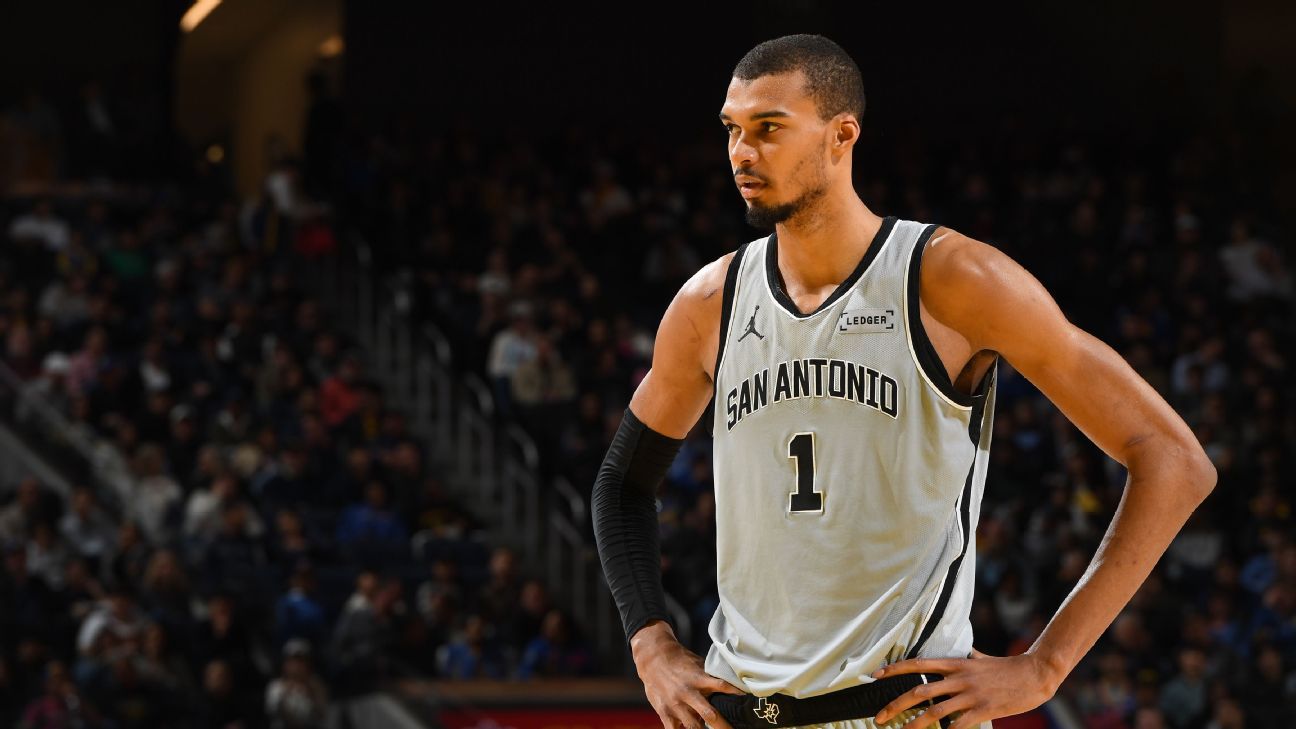
NOW IN HIS third NBA season, San Antonio Spurs center Victor Wembanyama has aged out of the Rising Stars competition at All-Star weekend. That didn’t keep the 7-foot-5 superstar from imposing an outsized impact on last Friday’s festivities.
Spurs rookie Dylan Harper stood near half court for tipoff of Game 1 of the 2026 Rising Stars event, pushing and shoving New Orleans Pelicans center Derik Queen for position as an official rushed over to intervene.
Queen lunged in response. Harper wasn’t having it.
As the Pelicans’ rookie reached out to shove Harper with his left arm, the Spurs’ guard grabbed it with a look of disgust on his face and slammed it down, just as the ball was tossed, showing a competitive fire rarely seen at All-Star festivities — ignited by Wembanyama’s approach to the events in Los Angeles.
A Spurs staffer joked later that Harper and teammates Stephon Castle and Carter Bryant — all Rising Stars participants — felt the Frenchman’s energy on the flight to Los Angeles and reacted accordingly. Minnesota Timberwolves star Anthony Edwards responded to Wembanyama’s intensity as well, saying the two-time All-Star “https://www.espn.com/nba/story/_/id/47978077/set the tone” for an All-Star Game that was the most competitive it had been in years.
“I’ve always thought to myself that if I was in [the All-Star Game], I’m never stepping onto the court to lose or not [play hard],” Wembanyama said before the weekend. “I’m thinking it’s [not] OK to lose. I’m going to be out there. I might as well win.”
Wembanyama and the Spurs plan to carry that same mentality headed into the last 27 games of the season on the hunt for the team’s first postseason berth since 2019. That quest resumed Thursday night in a 121-94 “home” win in Austin, Texas, against the Phoenix Suns, almost a year to the day that dreams of titles nearly died in the city of San Antonio.
On what sources described as a scary and emotional day full of confusion within the organization, news dropped last Feb. 20 that the Spurs would be shutting down Wembanyama for the rest of the season after doctors had diagnosed the young star with deep vein thrombosis in his right shoulder.
That devastating development registered as one sliver of adversity in a 2024-25 NBA season chock full of it. It started with Hall of Fame coach Gregg Popovich suffering a stroke before a game not even 10 days into the season that left then-38-year-old assistant Mitch Johnson in charge. Later came a game postponement in January that left the Spurs milling about hotel rooms in Santa Monica and later downtown Los Angeles, once smoke from wildfires in Malibu and Pacific Palisades started to encroach their location.
In addition to shutting down Wembanyama, the Spurs shelved trade deadline acquisition De’Aaron Fox, who underwent season-ending surgery last March to repair tendon damage in his gnarled left pinkie, leaving the team out of the playoffs for the sixth straight year on the heels of a 34-48 finish.
A season later, the Spurs hold the league’s third-best record (39-16) and a 13-7 mark against the NBA’s other nine teams with winning percentages of .600 or better (Detroit is the only team of this group San Antonio has yet to face) headed into Saturday’s matchup against the flailing Sacramento Kings at the Moody Center on the campus of the University of Texas. The Spurs’ rapid turnaround seems unbelievable — to everyone, that is, except Wembanyama.
“Not hard to believe, no,” he said. “Because I’ve seen everybody put in the work. I’ve seen everybody sacrifice things. [It’s] very believable but doesn’t mean it was easy by any means.”
WEMBANYAMA’S FIRST ALL-STAR weekend had not been particularly positive. San Antonio had lost four of six road games headed into the break last year, and Wembanyama’s schedule in San Francisco proved brutal. He had scored 11 points on 5-of-7 shooting in the championship of the league’s mini-tournament that replaced the traditional All-Star Game, though the effort level from the other players on the court left much to be desired.
Wembanyama said he felt exhausted coming off the Spurs’ final game before the All-Star break, a 116-103 loss to the Boston Celtics. He’d exhibited similar symptoms at the start of the trip on Feb. 3 in Memphis, but he’d chalked it up to a bug he had been trying to fight off.
“I think it played apart, not 100% of course,” Wembanyama said after Thursday’s win over the Suns. “But I mean I was 21 and still learning, still growing my conditioning. So, it doesn’t explain everything, but I think it explains a lot. I was feeling very, very bad the few weeks before I had diagnosis.”
While in Wyoming for a brief reprieve following All-Star weekend, Wembanyama started to feel discomfort and swelling in his right arm, and alerted the team’s medical staff. Once he returned, the staff ran him through a battery of tests, which detected a blood clot. The diagnosis sent Wembanyama reeling, leaving him to ponder his mortality both on and off the court.
“I remember the All-Star Game last year was the worst I had ever felt on a basketball court in my life because, I mean, I had 5% maybe of bloodflow in my right arm,” Wembanyama said.
In between taking blood-thinning medication, visits to doctors and grinding through a meticulous rehab regimen, Wembanyama decided after enduring this experience he described as “traumatic” that he’d embark on a journey to push himself physically and mentally through unconventional means. Wembanyama also wanted to make sure he was savoring many of the experiences that his superstardom afforded.
So, in addition to hosting a chess tournament at his court in Le Chesnay, France over the summer, Wembanyama visited Costa Rica and Tokyo, where he played soccer. He hung out at NASA’s Johnson Space Center and spent 10 days at a Shaolin temple in Zhengzhou, China, soul-searching while practicing kung fu and meditation with monks.
Wembanyama also met with Hall of Fame big men Kevin Garnett and Hakeem Olajuwon to pick their brains.
He wouldn’t officially play again for the Spurs until the Oct. 6 preseason opener.
“It was really just a sad time,” Johnson said Wednesday, shortly after the team’s arrival in Austin. “There was so much uncertainty. At first stage there was no basketball being discussed. It was health. It was well-being. It was really a flat moment for us. It was not long after we acquired De’Aaron, and I think they played five games together.”
It was sunny on the morning of the Wembanyama announcement with a brisk wind and temperatures hovering in the mid-30s. Spurs CEO R.C. Buford stood alone in the gym at Moody Center in Austin watching as the players filed in for shootaround ahead of a matchup against the Suns. Every player was accounted for except for San Antonio’s tallest. Reporters asked questions immediately. The club’s public relations staff disappeared into another room to determine how to best deliver the news it would reveal minutes later.
A 26-point performance by Fox that night in only his sixth game with the team pushed San Antonio to a 120-109 win. In the hallway leaving the arena, Fox expressed regret leaving Moody Center headed toward the team bus.
“We were ready to hit the ground running and you get news like that,” he said. “It is definitely a tough thing to overcome because of the production he gave us.”
San Antonio would drop 19 of its last 30 games, including 11 of the 18 Fox sat out. Wembanyama would use the time away to rehab and reflect, before embarking on a whirlwind summer of transformation in preparation for this season.
JOHNSON FIRST JOINED San Antonio as an assistant in 2016 for the team’s Austin G League team the same year the Spurs drafted current Pelicans point guard Dejounte Murray with the 29th pick.
Johnson had been working with Murray since the point guard was 15. So, once the Spurs began vetting Murray, Johnson also caught the organization’s eye because of his acumen as a coach and communicator.
“He’s going to be a head coach in this league for a long time,” Murray told ESPN. “He’s got the work ethic, the brains, the patience. He played the game. He checks every box, man. He’s not shy. He’s comfortable in any room he’s in. I still keep in contact [with Spurs players]. They love him.”
So did the organization’s brass after watching how Johnson navigated the ups and downs of a chaotic season filling in for Popovich and leading San Antonio through the maladies that forced the early ends of the season for Wembanyama and Fox, even without a full complement of assistants. Once the 2024-25 season ended, the organization felt confident, according to sources, in what Johnson might be able to do with a full staff, a healthy Fox and Wembanyama, and an offseason to implement his own strategies and style of play.
The Spurs removed Johnson’s title of acting head coach in May, naming him the franchise’s 19th coach while allowing him to fill out the staff of assistants led by associate head coach and defensive specialist Sean Sweeney.
Throughout all the turbulent times, dating to even before Popovich suffered the stroke, Johnson had earned the trust of the players to coach them just as hard as his predecessor. During a Spurs loss earlier this season in Memphis, the gravel-voiced Johnson screamed from the bench: “Get a f—ing rebound!”
“Pop kept it honest,” said forward Keldon Johnson, the longest-tenured member of the Spurs who is in his seventh season with the team. “And Mitch would always keep it 100 with me, not sugarcoat it, tell me when I’m wrong but also give you that praise. I feel like that builds trust. He’s earned that trust to be able to coach us, get on us and get the right response and get us motivated.”
That has enabled the 39-year old to coach in his first NBA All-Star event in his first full season as head coach. But Johnson says he believes none of his personal success or the team’s would have been possible had San Antonio not been beaten down by the trying season of 2024-25.
“Last year there was so much, and it was new for me, unplanned or prepared by me that I didn’t know anything other than just trying to get through that day or what we were going through,” Johnson said.
DESPITE FINISHING FIVE games out of the play-in race a season ago, the organization remained quietly confident in San Antonio’s ability to compete with any team in the NBA. Sources within the organization over the summer pointed to Johnson’s unshakable leadership in the face of adversity as one reason. But the bigger reason was the return of the team’s two stars, particularly the big man on whom they’ve hung their hopes for the future. When the club shut down Wembanyama last season, he was far and away the front-runner for NBA Defensive Player of the Year. Despite playing only 46 games, he still finished the season as the league’s leader in total blocks. This season he has picked up where he left off, averaging a career-high 24.4 points while shooting 51.1% from the field and 36.3% from 3-point range, both also the best marks of his young career. And his chemistry with Fox, whom the Spurs acquired from Sacramento after he specifically said he wanted to play with Wembanyama, has been much improved. Wembanyama and Fox played a total of 120 minutes together last season over five games with the Spurs, notching a net rating over that span of minus-2.4. This season, when the duo is on the court together, San Antonio’s record is 22-9 with Wembanyama and Fox producing a net efficiency of plus-10.9 in 645 minutes, according to ESPN Research. Although the Spurs rank 29th in on-ball screens and handoffs per 100 possessions, they average 1.25 points per direct play when Wembanyama sets an on-ball screen or handoff for Fox, good for the fourth-best efficiency among combinations to run 150 or more plays together, according to GeniusIQ. Then, there’s the return and continued development of Castle, the 2024-25 NBA Rookie of the Year. After shooting 42.8% a season ago, he’s up to 46.4% this season, showing improved efficiency with the same number of shots per game. Keldon Johnson, a contender for NBA Sixth Man of the Year, and starting small forward Devin Vassell are entering their primes at age 26 and 25, respectively. San Antonio’s 2025 draft picks — Harper at No. 2 and Bryant at No. 14 — are also contributing heavily. Seemingly, most of the roster is, considering the Spurs’ rotation features 10 players who have played 40-plus games this season. San Antonio is one of four teams that have had at least 10 players play at least 40 games this season, along with the Utah Jazz, Miami Heat and Boston Celtics, according to ESPN Research. The Spurs’ depth lightens the blow the club absorbs in the non-Wembanyama minutes. At the All-Star break last season, San Antonio produced a net efficiency of minus-7.9 with Wenbanyama not on the court. This season, the Spurs’ net efficiency without Wembanyama sits at plus-1.0. When Wembanyama sat out 12 games because of a left calf strain earlier this season, the Spurs went 9-3. “I don’t believe we’re ahead of schedule at all,” Bryant said. “I think we’re going to just keep rolling.” Pondering what lies ahead over the next 27 games, Wembanyama seemed eager — almost giddy — having led the Spurs to a record of 11-5 against teams currently in the top six of the Western Conference. San Antonio has suffered only three losses against Eastern Conference teams. “Only one way to find out,” he said. “But just like anything, what’s gonna happen is gonna happen. There’s gonna be some good. There’s gonna be some bad. It’s about how we react to everything.” The Spurs have shown as much all season, bouncing back from a disastrous 2024-25 campaign that eventually left Wembanyama soul-searching and the organization’s brass over the summer pondering the club’s next moves. But through it all, Mitch Johnson remains convinced San Antonio wouldn’t be here now without those arduous experiences. “I do think now, and I think probably more as time goes on, [last season] probably served as a vehicle for this team to be as close as we are,” Johnson said. “We’ve had a lot of unique, rare experiences. We’ve had some things that produce a lot of time together and they produce events that typically stir or produce conversations, and maybe a little bit more deeper conversations; things that make you reflect on life or things you’ve [gone] through. So, I do think it’s played a part in this group’s journey even though it isn’t necessarily directly involving basketball.”


